AI Website Builder for Business vs. WordPress: What Should You Build for the Long Term?
Published by: Erick Olivares
Date published: November 20, 2026

Abstract blurred close up of AI chatbot interface with prompt input field and text on dark screen, representing artificial intelligence, digital interaction, user query, and modern technology concept
AI has changed the economics of website development. Businesses can now generate layouts, write content, create code, and launch functional websites in a fraction of the time required by a traditional process.
We have built websites using AI alone, so this is not an argument against AI-generated websites. AI can be an excellent way to test ideas, launch campaigns, create prototypes, and establish a digital presence quickly.
The more important question is whether AI should be responsible for building the entire website system.
For some businesses, an AI website builder may be exactly what they need. For others, WordPress may provide a more stable foundation for long-term growth. The right choice depends on the website’s purpose, complexity, audience, and expected lifespan.

Relative search interest, not exact search volume. Source: Google Trends, United States, collected November 20, 2026.
When an AI website builder makes sense
An AI website builder can be a practical choice when a business needs to move quickly and the website has a relatively simple role.
AI can work especially well for landing pages, campaign sites, early-stage businesses, product prototypes, personal websites, and companies that are still testing their positioning. In these cases, speed and experimentation may be more important than building a complete digital platform from the beginning.
AI also makes iteration more accessible. A small team can explore different layouts, messaging, and content structures without waiting weeks for every revision. That speed can help a business validate an idea before making a larger technical investment.
The challenge begins when the website grows beyond its original purpose.
When a website becomes a business system
Many websites begin as marketing assets but eventually become connected to sales, publishing, SEO, analytics, ecommerce, recruiting, customer service, and internal systems.
As the business grows, the website may also need to support multiple editors, regions, languages, products, and integrations. At that point, it is no longer just a collection of pages. It has become a business system that requires structure, governance, and ongoing management.
An AI tool may produce an impressive first version, but the first version is only one part of the investment. Businesses also need to consider who will manage the content, how the website will evolve, and how difficult it will be to change direction later.
Why AI is unlikely to choose WordPress without strategy
When an AI system is asked to build a website without broader business context, it will usually optimize for speed, simplicity, and a visible result.
That can be useful, but it does not automatically account for the organization’s needs five years from now. AI may not know how many people will manage the website, what editorial workflows are required, which integrations will become important, or how much control the business needs over its content and data.
This is why AI is unlikely to choose WordPress on its own. WordPress is not always the fastest way to produce a first draft, but its value becomes clearer when a business needs a stable, flexible, and manageable foundation.
Why WordPress still matters
WordPress remains relevant because it supports needs that extend beyond the initial launch. For many businesses, it provides content management, user roles, revision history, structured publishing, integrations, and control over the website’s content and data.
That stability becomes valuable when a company changes its brand, expands into new markets, adds services, redesigns its website, or connects the site to new systems.
WordPress is not automatically the right answer. A poorly planned WordPress project can still become slow and difficult to maintain. The platform is only part of the solution; architecture, content strategy, implementation, and governance determine whether it creates leverage or technical debt.
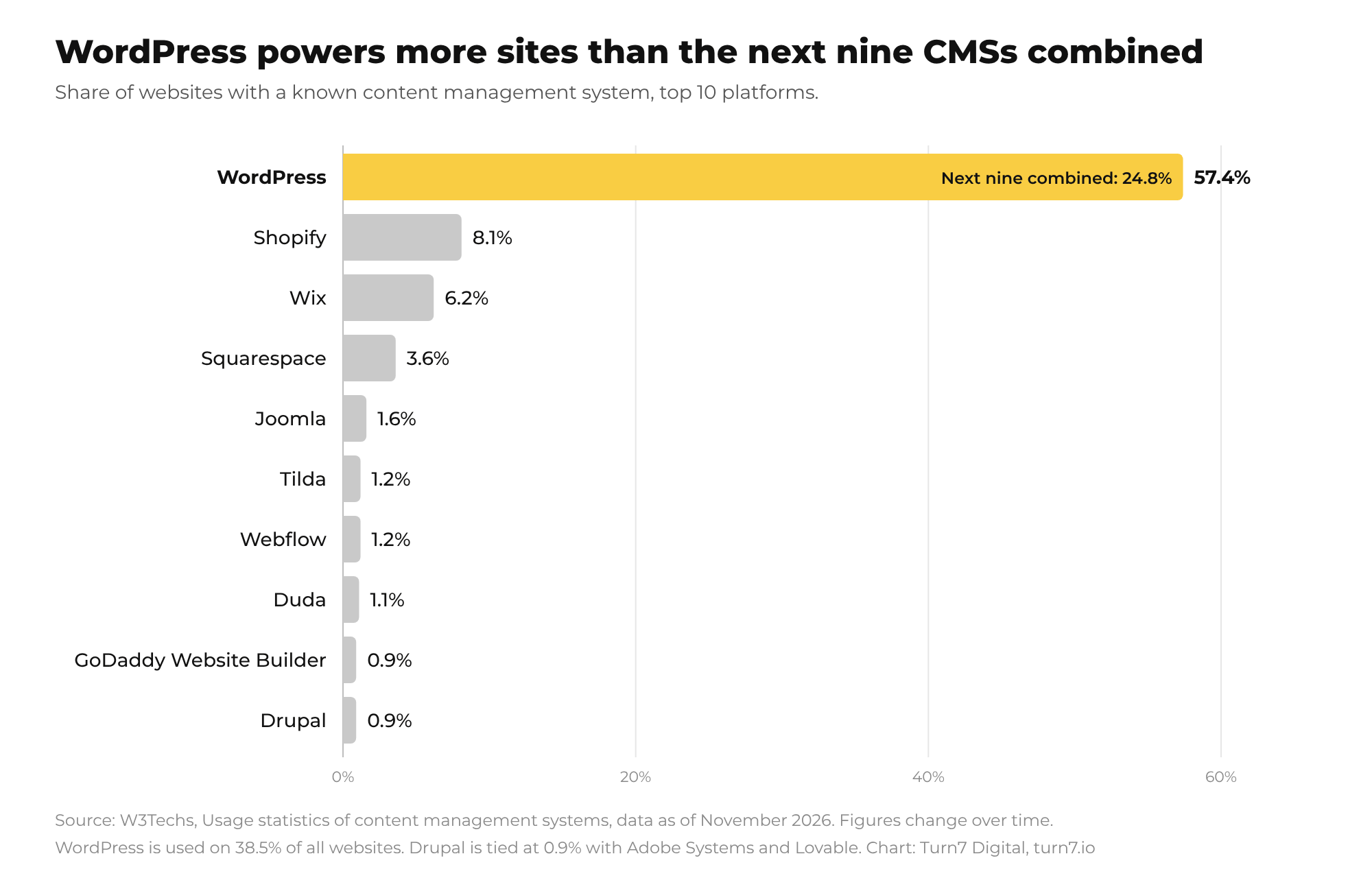
Share of websites with a known CMS, collected November 20, 2026. Figures change over time. Source: W3Techs.
The strongest approach may combine AI and WordPress
The decision does not have to be AI website builder versus WordPress. In many cases, the strongest approach is to use AI to accelerate the work while using WordPress as the long-term foundation.
AI can support research, sitemap development, content modeling, copywriting, design exploration, code generation, WordPress configuration, testing, accessibility reviews, SEO recommendations, and ongoing optimization.
The difference is that AI is working within a clear strategy instead of inventing the entire website system without context.
People define the direction, AI accelerates execution, and WordPress provides stability where the business needs it.

Turn7’s strategic framework, an illustrative guide rather than a measured benchmark.
Choosing the right foundation
An AI website builder may be the right choice when the business needs to launch quickly, has a limited website scope, and does not require complex integrations or structured content.
WordPress may be the better foundation when the website is central to marketing and sales, multiple teams will manage content, search visibility is a long-term priority, or the organization expects the site to support multiple markets, services, or systems.
The right answer may be an AI-generated website, a WordPress website, or a WordPress website built with extensive AI assistance. The important thing is to choose the foundation that matches the business goal rather than selecting a platform only because it can produce an initial result quickly.
AI can accelerate website development, but strategy determines whether the finished website becomes a durable business asset.